'Roman emperor moth conquers new lands !' 'Five new ways to use your angle paste .' 'When do the stars state you will marry?' ' Viae militares expand our hand over to foreign lands.' These whitethorn have been some of the headlines you would read in the Roman Acta Diurna – the daily notices many call the precursor to the modern daily newspaper.
The Roman Acta Diurna (translated from the Latin to mean value 'Daily Acts' or 'Day-to-day Public Records') were the daily public notices that were posted in certain public places around the ancient city of Rome. These notices kept the ancient inhabitants of Rome risen to date with current events. They controlled several forms of news, ranging from the official to entertainment, and even astrological readings.

Roman Angle Market. Arch of Octavius. ( Public Area ) The Acta Diurna was posted in public places close to the city.
Content of the Italian Stone, Gold-bearing, or Papyri "Newspapers"
The Acta Diruna is said to have first base appeared around 131/130 BC during the Roman Republic. At this point of time, the Acta Diurna , which were proverbial likewise As the Acta Popidi or Acta Publica , was carved on Isidor Feinstein Stone surgery metal. As the Acta Diurna were meant to reach a public audience, they were placed at overt places, such as the forum, the markets, or the thermal baths. Initially these notices reported 'serious' news show of importance to the Roman public, such as the results of legal proceedings, and the outcomes of trials.
- Ancient Opulence Outstation with Heated Jacuzzi served Roman Emperor in Bulgaria
- Dezful Bridge: The Oldest Operational Nosepiece in The Human race Was Built by 70,000 Roman Prisoners
- Boudicca, the Celtic Queen that unleashed fury on the Romans

'Cicero Denounces Catiline' (1889) by Cesare Maccari. ( World Domain ) Representation of a sitting of the Roman Senate. Initially the notices reported 'serious' news of importance to the Roman populace, so much as the results of legal proceedings, and the outcomes of trials.
As time went by, the range of topics reported by the Acta Diurna accrued as well. The contents of the Papistical notices began to admit in the public eye announcements, such as military victories, and the price of grain. Apart from these, the Acta Diurna also included other pieces of important information, such as notable births, marriages, and deaths, as well as tidings all but scrapper combats and unusual games that were being held in the city. The Acta Diurna even enclosed a gossip column, which often controlled the latest amorous adventures of Rome's sumptuous and famous.
By the time of the 1st century BC, the Acta Diurna was no more carved happening stone or metal. Alternatively, they were manus-graphic, all but in all probability on sheets of papyri. They continued to equal posted publically places, and after a couplet of years, were understood down to comprise archived. Regrettably, papyrus is not the most durable of materials, and No intact copy of the Acta Diurna is known to suffer survived cashbox the present day.
- Ancient Roman fort in England may have been constructed to give court to Mithra or Sol Invictus
- Fit Magnus Maximus, the Roman Usurper-Reversed-Welsh Hero Who Inspired King Arthur
- The Gladiators of Rome: Rip Sport in the Ancient Empire
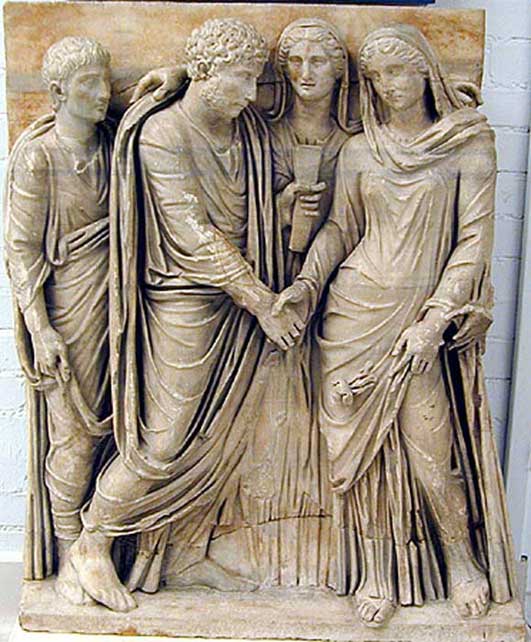
Fragment from the front of a sarcophagus viewing a Catholicity marriage ceremonial. ( CC BY Storm Troops 4.0 ) Notable marriages were mentioned in the Acta Diurna too.
Scribes Copied the News for Wealthy Epistle of Paul the Apostle to the Romans Living Outside City of London
The Acta Diurna were very touristy so. For example, the rich (presumptively those living outside of Rome) would often send scribes to City of London to seek out the latest variant of the Acta Diurna . These would then be copied and brought back to their patrons. Provincial governors would also send scribes to gain copies of the Acta Diurna for them, so that they were kept abreast of the latest happenings in the working capital. During this time, the conception of copyright was non in being, and the scribes could re-create the Acta Diurna freely.
The Acta Diurna were used besides as a rootage of information by various ancient authors. Suetonius, the author of The Lives of the Twelve Caesars , for example, is aforementioned to take up relied on the Acta Diurna for information about the dates and place of various births, deaths, and new important events. News form the Acta Diurna was too resourced by the Gaius Plinius Secundus the Elderberry bush, who wrote the encyclopaedic Natural Chronicle . In his work on, Pliny recounted a story he read in the notices, which was about a faithful dog WHO followed his dead master's body into the river at the funeral. Tacitus, who wrote The Annals and The Histories , saw the Acta Diurna as non worthy of coverage great humanistic discipline events, but alone good for trivial matters. Still, it is from this writer that we learn about the popularity of these notices, much so that they were brought to the long-distance provinces of the imperium by couriers.

Pliny the Elderberry bush. ( Public Domain ) Gaius Plinius Caecilius Secundus the Elder is one of the ancient authors who turned to the Acta Diurna for information.
The issue of the Acta Diurna continued until some 330 AD. As a leave of the decision by the Saturnia pavonia Constantine to move the capital of his empire from Rome to Constantinople, the Acta Diurna came to an destruction.
Top prototype: Relief from a scribe's grave found in Flavia Solva. ( Public Domain ) Ground: Latin stone inscription. ( Public Domain )
Away Wu dialect Mingren
References
Atwood, R., 2011. Acta Diurna (IT, 59 B.C.-ca. A.D. 222). [Online]
Available at: https://handwrittennews.com/2011/06/20/acta-diurna-it-59-b-c/
Early Church History, 2022. Acta Diurna—Rome's Daily Newspaper. [Online]
Available at: https://earlychurchhistory.org/communication/acta-diurna-romes-unit of time-newspaper/
Gross, J., 1988. Books of The Times; News, From 'Acta Diurna' to Forward-looking Media. [Online]
Available at: http://www.nytimes.com/1988/09/13/books/books-of-the-times-intelligence-from-acta-diurna-to-modern-media.html
Jeremy Norman & Co., I., 2022. Acta Diurna: the First Daily Gazette. [Online]
Obtainable at: HTTP://www.historyofinformation.com/enlarged.php?id=1636
Pack, M., 2011. The Acta Diurna, or how the Romans had an internet-savvy approach to information. [Online]
Available at: https://www.markpack.org.uk/27645/the-acta-diurna-or-how-the-Epistle of Paul the Apostle to the Romans-had-an-cyberspace-savvy-glide slope-to-info/
Pruitt, S., 2022. 8 Inventions We Owe to the Ancients. [Online]
Available at: hypertext transfer protocol://www.history.com/news/history-lists/8-inventions-we-owe-to-the-ancients/print
What Was Fed to Gladiator Fans During the Roman Empire?
Source: https://www.ancient-origins.net/artifacts-ancient-writings/acta-diurna-telegraph-ancient-rome-bringing-you-all-latest-gladiator-021770
Postar um comentário