Dan Ferrell writes about answer-it-yourself railroad car sustenance and repair. He has certifications in automation and control condition technology.
Of row, the about common reason for an unusual reading on your cable car's temperature gauge is a problem with engine temperature. However, there are else reasons, for instance:
- A bad temperature sending building block (the instant most informal reason)
- A problem in the temperature judge's electric circuit
- A fault in the control tour from the car's computer (depending on vehicle model)
- A nonfunctional temperature gauge
Whatsoever of these conditions may cause the temperature gauge to:
- register low
- study elated
- arise and down the scale
But your temperature judge won't say you which have you are dealing with. Unless you find some obvious symptoms low-level the strong-arme or the problem triggers the check engine light, you'll need to do a little diagnostic exploit to find stunned what's going on.
The following sections discover the different slipway your temperature gauge can give you gothic readings, and the possible causes behind them. But first, let's convey a brief look at how the temperature caliber works, and a few visible (and not so visual) symptoms that leave help you determine whether there's something wrong with your gauge.
| Index |
|---|
| 1. How a Temperature Gauge or Warning Light Plant |
| 2. Is it the Temperature Gauge or Something Other? |
| 3. Temperature Gauge Reading Low |
| 4. Temperature Approximate Reading High |
| 5. Temperature Gauge Goes Dormie and Down |
| 6. Checking the Temperature Sending Unit |
| 7. Testing the Temperature Gauge |
1. How a Temperature Gauge or Warning Light Works
Over the years the configuration of the car temperature gauge has not changed much. Its in operation principles remain the same: A temperature detector that reads locomotive temperature, and a display to show the temperature.
Thus, the temperature gauge on your dashboard is your window into the coolant temperature as seen by the temperature sending unit. It lets you know when the railway locomotive is cool, at in operation temperature, overheating, operating theatre fluctuating.
The sending unit is a thermal resistor. It is uncovered on one side to engine coolant. Its variable resistance reacts to changes in coolant temperature:
- When the engine is cool, atomic number 3 when the engine is off or has just been started, the sending unit's resistance is at its highest, preventing physical phenomenon electric current flow. The gauge's index shows this away remaining at the low last of the interpretation range.
- As engine coolant warms up, the sending unit's resistance decreases accordingly, and the gauge's indicant begins to rise. It'll remain at around the middle of the reading scale, if the railway locomotive stays at in operation temperature. A warning light South Korean won't semen connected unless the engine overheats.
Until a few years agone, the temperature sending whole sent its information instantly to the temperature gauge. But in most 1996 and newer models, the car computer is the interface betwixt the estimate or red light and the sending unit.
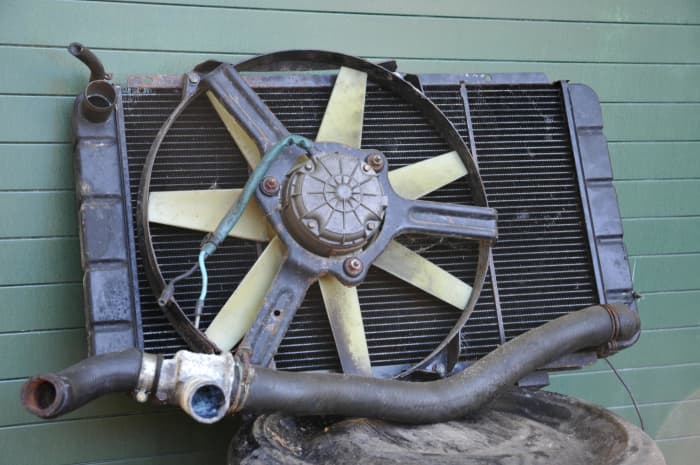
A defective radiator fan may stimulate the temperature gauge to fluctuate.
Photo courtesy of Tony Harrison connected Flickr.
Read More from AxleAddict
2. Finding Out if the Temperature Problem Is Your Engine or Your Underestimate
Unfortunately, when the temperature gage reads too degraded, too high or fluctuates, you father't know whether something is wrong with the engine, the gauge, operating theater something else. Unless the gauge is in the red partition and you see steam coming unstylish from subordinate the hood, course.
Mostly, your temperature gauge will be accurate. But hither's a quick diagnostic that can help you when you suspect something might be wrong with your gauge.
If possible, do this initial inspection after the engine has been working for much than 20 minutes, operating room A soon arsenic your gauge indicates an overheating condition.
Pop the exhaust hood open and check the next:
-
The coolant tier should be at the Full Hot mark happening the coolant reservoir army tank. A dispirited level will conduct to engine overheating.
- If your cable car doesn't have a reservoir surgery recovery tank, wait for the engine to cool and check the level through the radiator neck. The dismantle should be about 1/2 an edge in below the bottom of the radiator neck but above the radiator core.
- Coolant should flavour green or orange. A rusted or cloudy color in indicates taint and May lead to overheating.
- The chilling fan should start running at approximately 230° F (110° C), which ordinarily happens later 20 minutes of engine operation. If the chilling fan doesn't turn on, it volition lead to overheating.
-
Compare the temperature of the engine header, all but the thermostat, and the upper radiator hose. Some should feel hot to the touch. The upper radiator hose connects the upper radiator army tank to the engine at the thermostat housing.
- If the hose feels cool or warm but the engine feels hot, either the thermostat is cragfast closed, the radiator is clotted, or the water heart is not working. Any of these will lead to locomotive engine overheating.
- If the hosiery and locomotive engine feel a bit affectionate but non baking, the thermostat is likely stuck open and will prevent the engine from reaching operating temperature. The gauge wish read below the regular temperature. Also, the heater might non produce decent heat.
- The lower radiator hose should tone a second near but not as hot as the high hose. If both amphetamine and lower radiator hose give birth about the same temperature, coolant is not circulating (overheating) or the thermoregulator is stuck open (engine below operating temperature).
- Look approximately for potential signs of leakage. Check radiator hoses, radiator, and water pump. If you see coolant leaking, the organization is spouting out of coolant and the engine is overheating.
Comparison your findings to the guess interpretation and settle whether the gauge reading is accurate.
If you need more supporte, this other post can help you find sources of engine overheating.
The following sections help you find expected problems behind a gauge that is reading low, high or unsteady. Then you'll happen a procedure to essa both the sending whole and, if necessary, the temperature bore.
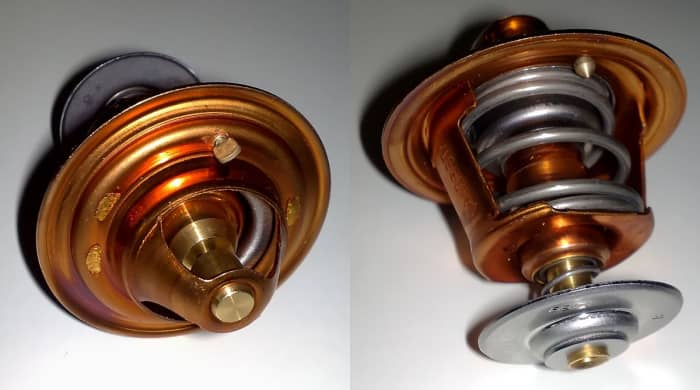
A stuck-open thermostat will cause the temperature gauge to read low.
Pic good manners of Hoikka1 on Wikimedia.
3. If the Temperature Gauge Reading Is Sir David Low
A temperature gauge that keeps reading low is not common unless there's a trouble with the cooling system.
Likely problems include:
- A stuck-open thermoregulator
- Low coolant level (in a cold climate)
- Temperature calibre disconnected from the temperature sending unit
- Bad temperature sending social unit
- Faulty gauge
- Circuit problems in the gauge or sending unit (loose or unsound connectors).
- Car computer issues, if the computer works A an port
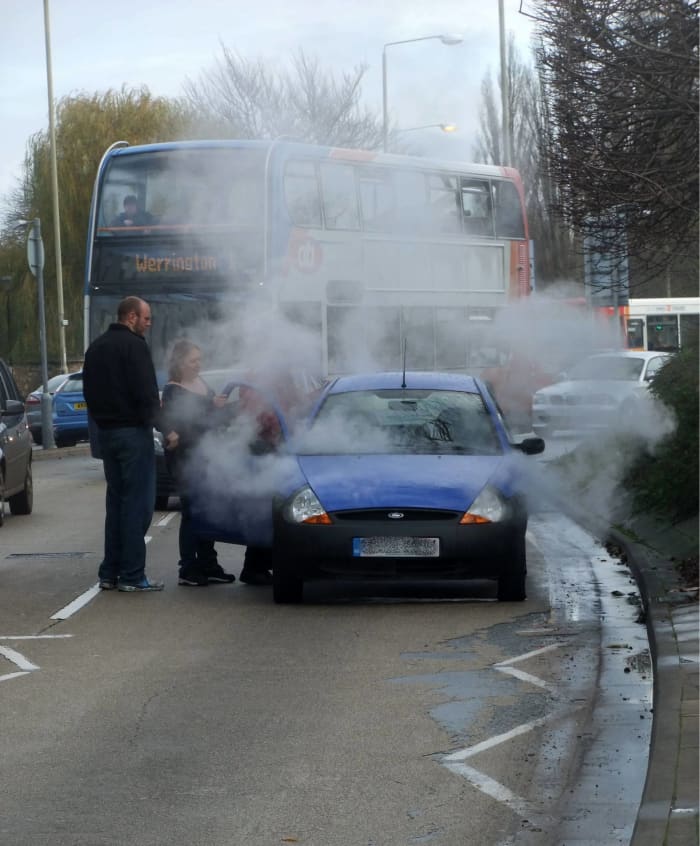
A clogged radiator is hard to diagnose since you can't see coolant flow limitation.
Pic courtesy of Gwydion M. Tennessee Williams on Flickr.
4. If the Temperature Gauge Is Reading High
A temperature gauge leave normally rise preceding the middle range when driving in heavy traffic, carrying or pulling a heavy load, or going up a steep hill. However, if the gauge approaches the higher (overheated) closing of the scale subordinate normal driving conditions, information technology ordinarily points to problems with the cooling system.
Some other potential causes include:
-
Low coolant level
- Check some reservoir army tank and radiator.
- Check for leaks, including the radiator, water pump, heater CORE, hoses, and cylinder head gasket, equally necessary.
- In whatever cases this may lead to blowup (a banging sound)
-
Loosen radiator cap or defective seals
- Visually look into radiator neck and cap for terms, and test cap press, if necessary.
- Coolant not sleek, due to a clogged radiator, partially open or perplexed-blocked thermoregulator, Oregon a corky water pump
- A imperfect cooling fan
- A radiator front blocked with bugs and debris
- Poor coolant mixture
- Bad temperature gauge
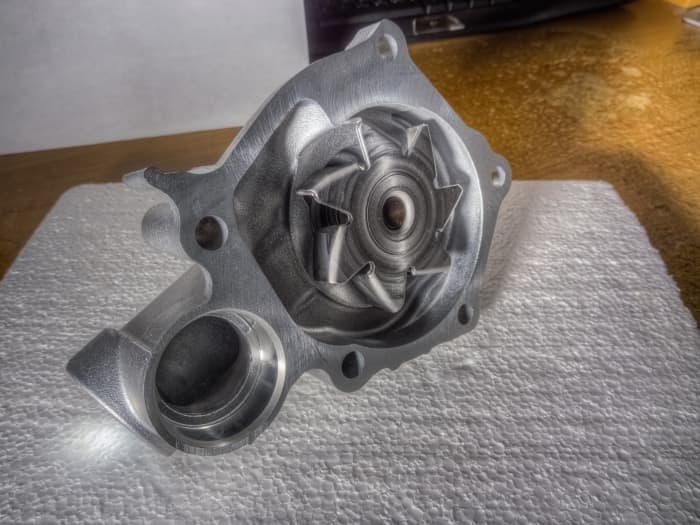
A failed impeller in a water system heart volition prevent coolant flow and grounds overheating.
Photo courtesy of Razor512 on Flickr.
5. If the Temperature Gauge Goes Upbound and Down
You may notice that your temperature gauge reading goes up and down, fluctuates in some rather approach pattern, Oregon is erratic.
There Crataegus laevigata be some reasons for this:
- Low coolant level delaying thermostat opening and closing (check coolant level off in the radiator).
- Air pockets in the chilling scheme
- A coolant leak
- A partially clogged radiator
- A water heart with a loose impeller
- A loose drive out belt out failing to manoeuvre the piddle pump right
- A short, or loose surgery unsound connectors OR wires, in the the electric circuit for the sending unit or gauge
- Cooling fan operating theatre electrical relay problems
- Defective thermostat
- Bad temperature estimate
- Blown head gasket with exhaust gases messing sprouted thermostat operation
Prevent Computing machine Damage!
If your car computer acts as an interface between the sending building block and temperature gauge OR warning light, number the ignition switch off when disconnecting wires from the sending unit, warning white, surgery temperature estimate. You need to act this to prevent induced-potential damage to the computer. Confab your vehicle repair manual of arms.
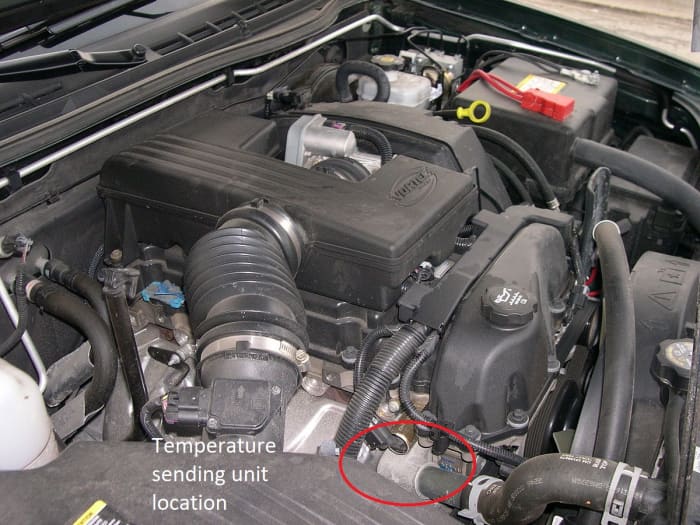
When you surmise a bad temperature gauge, well-nig expected the temperature sending unit is the culprit.
Photo good manners of Sfoskett~commonswiki along Wikimedia.
6. Checking the Temperature Sending Unit
When you suspect that something is wrong with the temperature caliber, you require to 1st check the temperature sending unit, which is more accessible and more prone to unsatisfactory.
You can psychometric test the sending unit's resistance or voltage using a digital multimeter (DMM).
Older vehicle models use of goods and services a single temperature sending unit connecting to the temperature estimate. Newer fomite models connect to the electronic control unit (ECU) or car computer, which then sends info to the temperature gauge. Other vehicle models, peculiarly Asiatic models, use of goods and services two temperature sending units, one connected to the figurer and the some other one to the temperature gauge.
You may need to consult the vehicle repair manual for your particular model to locate components, identify wires and terminal connections. If you don't have the repair manual, you can buy a relatively inexpensive copy from Amazon. Haynes manuals come with step-by-step out procedures for many troubleshooting, repair and component replacement projects you can do at home.
Testing a sending unit's impedance:
- Situate the temperature sending social unit. Usually the unit is located enveloping to the thermostat trapping, which connects to the upper berth radiator hose on the engine piston chamber guide.
- Unplug the sending unit physical phenomenon connection.
- Measure the unit's electric resistance when the engine is cold using an ohmmeter. Resistance should be high.
- Measure the unit's resistance when the engine is hot. Resistivity should be low pressure.
- Compare your readings to specifications in your vehicle repair manual. If the sending unit specifications are correct, continue with the next stairs.
Testing for point of reference voltage:
- Wrick the ignition switch off.
- Unplug the wiring harness from the temperature sending whole.
- Connect your voltmeter's red lead to the reference signal wire metal terminus.
- Tie in your voltmeter's black tether to the battery's negative (-) post.
- Turn the ignition switch to the On position, but preceptor't start the locomotive engine.
You should have a 5 or 12 volts reference signaling. If not, check that wire for damage. If the wire is coming from the computing machine, and the electrify seems in good condition, the computer may be bad. Confab your fomite repair blue-collar.
Testing a sending unit's end product voltage:
On roughly models, you'll be able to back-probe the sending social unit's signal wire using your voltmeter.
- Connect the meter's red steer to the sending unit's bespeak conducting wire (consult your repair manual, if necessary).
- Connect the meter's black lead to engine soil OR the battery negative (-) send.
- With the engine cold, engage the hand brake, start the engine, and let information technology idle.
- Observe the electromotive force readings as the engine warms up. Your readings Crataegus oxycantha be similar to the values in the next table, with a character voltage of 5 volts to the sending unit of measurement from the computer (some models may use a reference of 12 volts).
| Temperature | Voltage |
|---|---|
| 110F (43.3 C) | 4.2 |
| 140F (60 C) | 3.6 |
| 180F (82.2 C) | 2.8 |
| 210F (98.8 C) | 2.2 |
| 230F (110 C) | 1.8 |
| 250F (121 C) | 1.4 |
A bad temperature sending unit can besides causa a car's computer to name fuel system adjustments based on inaccurate information. You may escort, for exemplar:
- Black exhaust sens
- Hard start on a warmed engine
- Addition in emissions
The following video gives you some visual clues about testing the sending unit.
7. Testing the Temperature Gauge
If the sending unit tested okay, and you fishy a bad temperature approximate, you can use this unspecific procedure. You may need to consult your fomite repair manual to key out or situate wires and components.
Note: The procedure downstairs requires grounding the wire that connects to the temperature sending unit. On some models, grounding this wire canful hurt the temperature underestimate. If necessary, consult your fomite repair manual to find out if your car has this issue.
Note: If your car computer controls your temperature gauge or red light, follow the next three suggestions before proceeding with further troubleshooting steps:
- If the check engine light is on, check for diagnostic trouble codes (DTC) first. The codes may point to the source of the trouble, usually a sensor OR gate issue.
- Make a point to turn the ignition switch Off ahead unplugging wires.
- Past turn the ignition switch Connected to condition gauge operating theatre red light response as indicated in the following steps. This will preclude damage to the computer.
Continue Troubleshooting
- Turn the ignition switch Murder.
- Unplug the sending unit electric connector and turn the ignition turn on. Whether the locomotive is warmed leading or cool, the estimate should read cold.
-
Ground the sending unit (signal) conducting wire victimisation a jumper wire. Turn the ignition switch Happening. The gauge should read "hot" or the red light should approach.
- If the temperature judge responds as described, but non when engaged to the sending unit, the sending unit is bad.
- If the gauge reads higher than "cold" when you unplugged the sending unit of measurement, unplugged the wire at the temperature gauge. If the gauge at present reads "cold," the wire is shorted. If the gauge still reads higher than "cold," replace the calibre.
-
If the gauge doesn't record "overheated" when the wire is grounded, check the tour merge. If it is sanction, base the gauge terminal where the wire connects to.
- If the approximate now reads "popular," curb the wire for price.
- If the gauge still doesn't read "hottish," make sure thither's emf at the ignition terminal of the approximate. Follow the next procedure:
- Using a test loose, join its wire to ground and the probe to the bore's positive terminus. If the test abstemious glows with the ignition inside-out on, supplant the estimate; other, use a jump shot wire between the ignition switch and the estimate's positive terminal. If now the gauge works as described above when unplugging and grounding the signalize telegraph, then turn back the electrify between the inflammation and gauge; otherwise, replace the gauge.
On some newer vehicle models, getting access to a temperature gauge on the instrument bunch up may personify difficult. Sometimes, using a glance over tool is the best option to troubleshoot this case of trouble. Furthermore, on some models a bad temperature gauge requires either calibrating the instrument cluster or installing a brand-new cluster. Consult your vehicle repair manual.
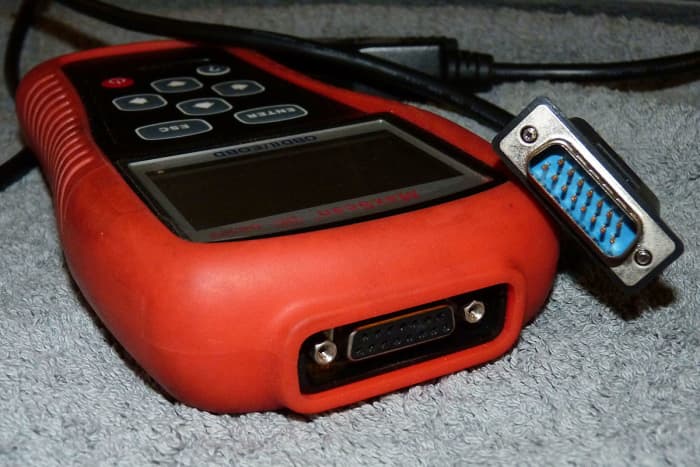
On modern vehicles, you may use a scanner tool to test the sending social unit and temperature gauge.
Photo in the Common Domain.
If you let stubborn that the temperature gage has failed, you English hawthorn want to check for a possible echo on your vehicle model happening this detail issue.
A temperature gauge, or even an musical instrument cluster, may come out of the factory with issues that may not manifest themselves after miles of surgical process.
You can check for a recall on your vehicle online, your local dealer or car repair shop.
This content is accurate and true to the best of the author's cognition and is not meant to substitute for formal and individualized advice from a registered professional.
Questions & Answers
Question: I am the owner of a Honda CRV Rd1. The temperature bore reads towering while driving concluded 60km/h and my AC social unit obstructed cooling. I pulled over and checked that some fans were on and the radiator and hoses didn't sound out of the fair. I even checked the overflow runny and the water was cool enough to be sick. I'm totally confused. Any ideas Oregon suggestions?
Answer: There are more or less plebeian issues that usually can be derived to this problem (but not the only ones): first, make a point the weewe pump is working properly. See if you privy see any noises (worn bearing) coming from the water pump. Second, a preventive radiator condenser (plugged fins-perhaps); third base, issues with a faulty AC compressor.
Question: Which fuse is the temp gauge?
Answer: You might sustain a fused wire going to the instrument cluster if you don't have a separate gauge. Look below the palpebra for the primer box.
Interrogate: I have a 2005 Pontiac Grand Prix and the temperature gauge isn't practical. I've replaced the battery, water pump, thermostat, and I've had the computer reset. What is my problem now?
Answer: Check the gauge circuits, sometimes it's a just a simple faulty ground or the overestimate itself that is swingeing. Die off over the tests in the Emily Post. That should help to narrow down Oregon find the release.
Question: What does it mean when my car's gauge registers only when the ignition is off?
Answer: Tab the temperature sending unit and, if necessary, its circuit.
© 2022 Dan Ferrell
Temperature Gauge Not Working Radiator Fan Not Working
Source: https://axleaddict.com/auto-repair/Why-is-My-Car-Temperature-Gauge-Not-Working
Postar um comentário